As Words and Sentences Buzz
📖 On Reading and Writing: Its Sacredness and Exhilaration_Go Mi-suk
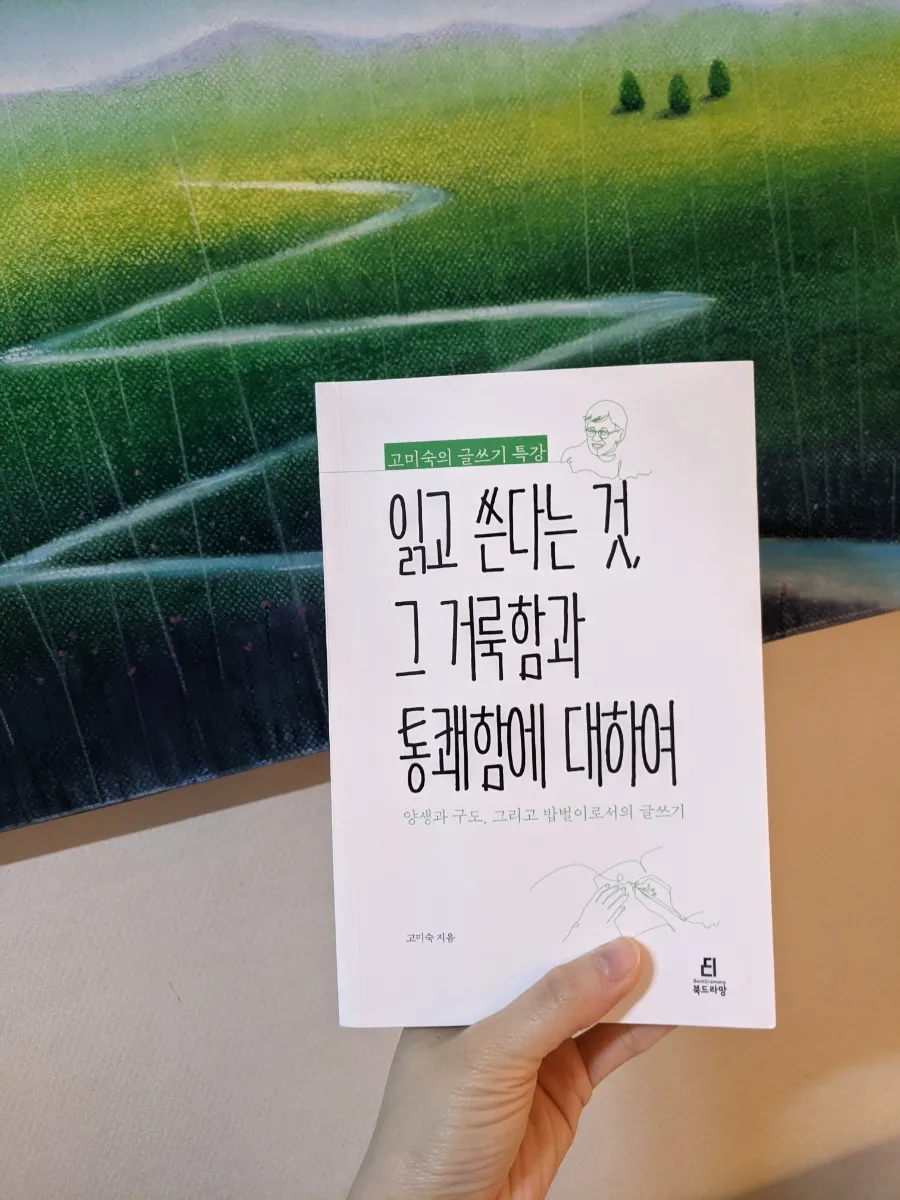
It was a book I bought out of curiosity after accidentally reading a few sentences from an editor’s recommendation.
It’s not a story about the secret to writing well (is there really such a secret that applies to everyone? I believe that just as each of us has a unique personality, writing also contains one’s own style, which isn’t acquired by following a manual but by forging it oneself). Instead, it delves into the fundamental philosophy of why one should write, so I bought it without hesitation.
It was a satisfying and fulfilling read, full of sacred content that motivated me in my writing. It felt incredibly exhilarating to read such a refreshing answer to the thoughts and feelings behind my obsession with writing!
📝 My Favorite Thoughts and Sentences
Classical writing overflows with truly diverse forms beyond poetry, novels, and criticism. But that’s not what’s important. What matters is whether it’s literary or not. Indeed! The 20th century was the era of ‘literary-ism,’ and writing was merely producing literature or texts surrounding literature. It was a truly grand, yet terribly persistent fantasy. If I had become a professor, I would have floundered in this delusional web my entire life. Just escaping from that has made my forties fulfilling!
**
The principle of writing is similar. To encounter things ‘as if for the first time,’ to invent differences at every moment, and to connect the invisible – this is the driving force of writing. It is a path back to the primordial mystery when humanity first stood tall ‘between’ heaven and earth, and also a way to awaken the moment a newborn first encounters the world.
**
It’s not just Buddhism. All religions and philosophies that emerged 3,000 years ago in the so-called ‘Axial Age’ (Jaspers) cried out with one voice: How can we escape from the self that adds thought upon thought? How can we stop, empty, and break free? In an individual life cycle, this might be around middle age. When one reaches their 50s or 60s, after dedicating their youth to expansion and proliferation, they suddenly face a vast emptiness. A moment of profound futility and loss pierces to the bone. If one cannot cope with it, it becomes depression or Hwabyung. Adding thought upon thought will never break through that situation. One must escape from thought. One must stop thought itself. You will experience the paradox that stopping is the highest form of agency.
**
As long as you live, you must read. Read the sun and moon, read the weather and seasons, read the morning birds and the evening glow. Ah, people are also ‘books.’ A person is a story, a text, in themselves. Therefore, meeting someone is like accessing the book of their daily life, and furthermore, their entire life.
**
This is the joy that books provide. Within that joy, a ‘new space of freedom’ opens up. It is truly a sacred experience. If I were to willingly share my testimony, the change that occurred in me was this: People think that reading many books increases knowledge. No, that’s not important. What’s truly important is the wonder of discovering oneself in all those books.
**
Modern people are truly capable, but there is one area where they are severely incompetent: rest. Rest is a skill. Playing well and resting well are not as easy as they sound. They also require life’s inner strength. Let’s consider this carefully. To truly rest, one must first escape the stress of labor and money. Daytime labor is difficult not because of the work itself, but because of the alienation and pressure it brings. Doing work one doesn’t want to do is alienation, and being forced to produce results is pressure. So, resting means escaping these two things.
**
Nomadism, renunciation, revolution – these are all keywords that demand a transformation of existence. To live in a different way than before. To become a different being. Do you agree with this? If not, you must continue to ask yourself. As you ask, observe and watch the world, history, and the cosmos. This is reading. If you do agree, then the next question is simple: How do you train for it? Even steel becomes a useful tool and a shining jewel only after countless tempering. The same goes for thought. To know is to advance step by step towards that horizon. Without advancement, it is not knowledge. ‘I know, but that’s enough!’ means ignorance, and that ignorance will become cynicism, freezing everything around it.
**
Humanities is the act of drawing a map of life. It cannot be done half-heartedly or carelessly. You can enjoy exercise even if you do it casually. The same goes for music and art. But you cannot casually explore life. If someone tells you to live carelessly, you would feel insulted. Why? All living beings die. Without exploring death, there is no way to cross this sea of life and death. To explore death, life must change.
**
Hear and convey, speak and listen, read and write! These are activities that a person must fully embody. The body desires all of them! If you dwell on only one, your qi and blood will become blocked. If blocked, it hurts. Both body and mind. Tongjeukbultong (‘If it flows, it doesn’t hurt / If it hurts, it doesn’t flow’) – this is the principle by which writing becomes a method of nurturing life (yangsaengsul).
**
Controlling the mind and extinguishing the flames of desire are now becoming the foundation of an industry, beyond simple healing. This will become even more true as artificial intelligence develops exponentially. In that case, shouldn’t everyone become a seeker of their own life? Indeed, perhaps there will be no other work for humans to do. To become a seeker, one must explore life, and writing is essential for that.
**
It’s common to collect moving passages, wonderful metaphors, and brilliant ideas, only to struggle because one cannot fully process them. They haven’t been sufficiently digested. If undigested, the food remains clumped in the stomach and spleen. In such cases, one must boldly break through and let it flow. The same applies to sentences. As Deleuze/Guattari often put it, ‘cutting, extracting’ is close to this. When thoughts and words are scattered and tangled, one must boldly ‘cut’ through the flow. Only then can one ‘extract’ them into one’s own sentences.
**
Therefore, one must read and write. Especially, one must swim in the sea of classics. What are classics? They are a fundamental exploration of existence and the world. Thus, as you explore the world of classics, you are bound to encounter those sages. This is because all domains of Eastern and Western intellectual history lie within the ideological web of those sages. It’s the same no matter which era or author you explore. Even if you read Nietzsche, you must know Christianity, Socrates, and Greek tragedy; and if you read Yeonam, you are bound to encounter Yangmyeong, Zhu Xi, and Confucius. The same applies to political economy, natural science, art, and anthropology. Any journey of knowledge leads to the sages of the ‘Axial Age.’ You will inevitably encounter the message of compassion and empathy they expounded. Connecting to that wave of wisdom is precisely reading and writing.
**
In fact, the content of a book constantly changes depending on how you encounter it. This is especially true for classics. A classic isn’t a classic if it doesn’t possess these multi-dimensional transformations. If anyone reads it and the content is always the same, what do you call that? A textbook. That’s why everyone finds textbooks boring. But if people write reviews of the same book and they all sound similar, what does that mean? It means they didn’t truly ‘connect’ with it; they just memorized something from somewhere. That’s when we call it trite. It can never be the same, even if you read the exact same book. Language is more physical than skin, isn’t it? Any language, as it passes through my body, changes its nuances, grammatical structures, arrangements, and so on.
**
How can one develop self-esteem if they cannot give meaning to their own life? With self-esteem, one can treat the people they meet genuinely. That power to create a genuine attitude is precisely concentration, and that’s why we must read books. Therefore, that power and wisdom must be accessible at any time. In other words, reading books and writing is acquiring the best asset that can always be drawn upon throughout one’s life.
**
It’s a process of reading and re-reading a text, creating a physical chemistry, and based on that, spewing out new texts, yet another text. When this physical chemistry occurs, words and sentences buzz and murmur, and one cannot help but pour them out.
**
I once wrote a piece based on a word that suddenly came to mind while exiting Suyu Station Exit 4. So, once thoughts and words start moving, you realize that the amount of time isn’t a big issue. It’s not about quantity, but the true density of the encounter. Therefore, if you’re writing and feel stuck, it’s good to change your rhythm by taking a walk or cleaning. Don’t just cling to your laptop, sighing and browsing the web.