Hazy Sorrow Has Settled
📖 Frog_Mo Yan
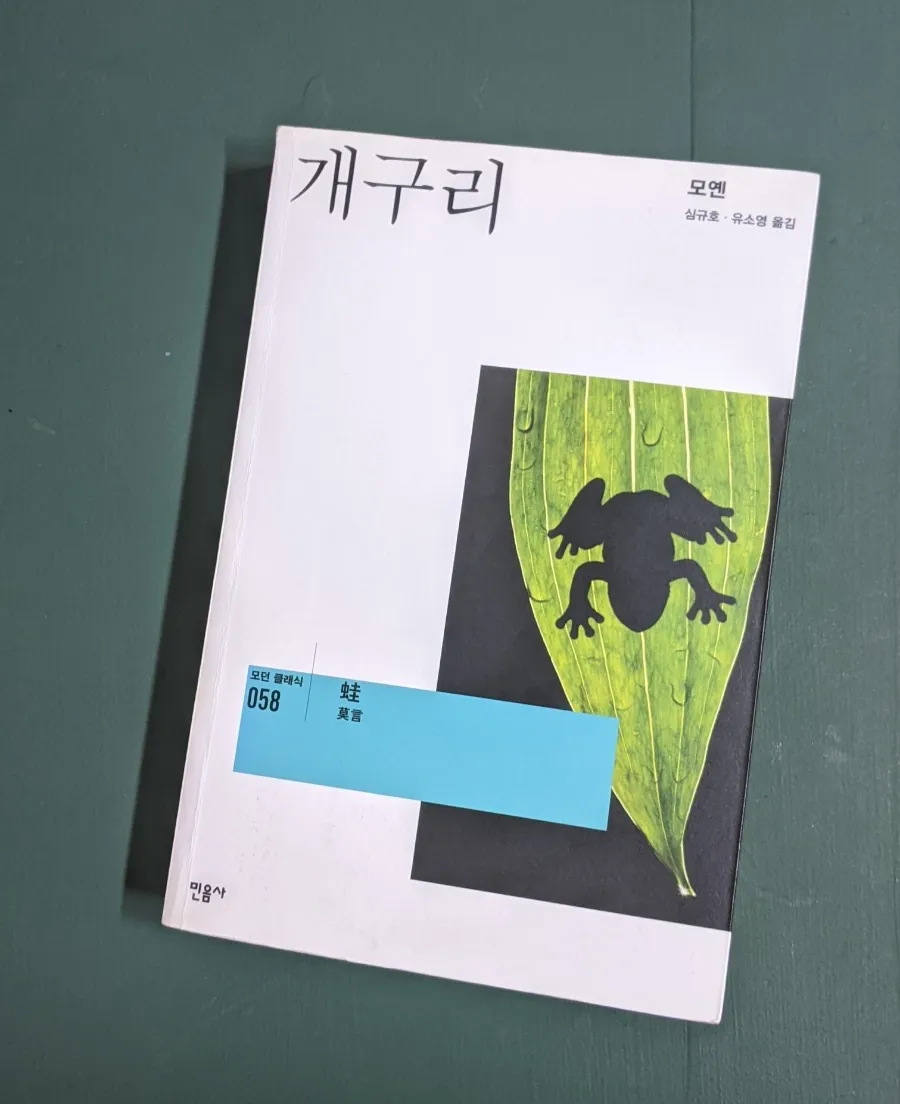
I finally finished
Regarding China’s planned birth policy, the one-child policy,
I had only briefly heard about it during social studies classes in school and didn’t know much about it.
The novel, which contains author Mo Yan’s personal experiences, revealed stories of the hazy sorrow hidden behind the name of the planned birth policy.
I once again feel that the world of those who read novels and those who don’t is distinctly different.
I, too, deeply resonate with Minumsa’s intention in publishing the Modern Classics.
On Publishing Modern Classics **
The prejudice that classics are books of the past must be dispelled. Young classics, existing in their most vibrant and captivating forms today, are right beside us. Not legacies of the past but living classics, these ongoing classics are what we choose to call ‘Modern Classics’.
Since the latter half of the 20th century, the world has been forming a global literature for more readers than ever before. ‘Modern Classics’ transcend regional boundaries, showcasing the cutting-edge literature of this era through young masters from various countries who have already become global stars. These young classics, the most vibrant world literature of the present and a roadmap for future literature, are a treasure trove of the times and a legacy for the future.
Literature that transcends time and always communicates with the present is called a classic. Regardless of the amount of time it has endured, a classic always exists here. ‘Modern Classics’ will breathe with the readers of this era and forever beckon to future readers.
**
**
📝 Thoughts and Sentences I Liked
pg.9
It was only after many years that I finally began to write my aunt’s story. It wasn’t because I suddenly found courage, but because I found a way to solve the problem. The method was actually simple: it was to write about my aunt. I told myself very clearly: I am not writing a history of China’s ‘planned birth policy,’ but a novel, and the most important thing in writing a novel is to write about people. I decided to ‘look squarely at people and write.’ Taking my aunt as the archetype and adding fiction and imagination, I would create a character that had never before appeared in world literature. If I could properly portray such a character, the novel would succeed; otherwise, it would fail. If written this way, the ‘planned birth policy’ would become a historical background, something necessary for shaping the character.
pg.131
Blood flowed from my aunt’s head. Even now, there’s a wound the size of two coins on her head. The blood ran down her forehead to her ears, but my aunt stood perfectly still, not moving an inch. Amidst the silence below the platform, a donkey pulling a cart stretched its neck and brayed at the top of its lungs. My mother’s cries were not heard. A hazy sorrow settled in my heart.
pg.294
More than ten years ago, I once said that to write, one must touch upon the most painful parts and write about the memories one least wants to revisit in a lifetime. Even now, I believe that one must put into words the most awkward stories, the most embarrassing incidents of one’s life. One must place oneself under the surgical light on the dissection table.
More than twenty years ago, I brazenly declared, ‘I write for myself.’ Of course, writing for atonement is also writing for myself. But this is not enough. I believe I must also write for those I have hurt, and at the same time, for those who have hurt me. I was moved by them, because every time I am hurt, they remind me of those I have hurt.
pg.336
In my youth, I was someone who mastered the ways of the world through love. Things like honor or profit are like fleeting clouds to me. I say this because I want to tell you about miracles. I want to let you know that dreams and artistic creation are inseparable, that heartbreak is an immense treasure, and especially, that those who engage in artistic creation cannot reach the highest echelons of art unless they temper themselves through the pain of heartbreak.
pg.374
It would be even more wonderful if I could sit across from you, teacher, here. My apologies. Writers always like to stimulate their creative passion through such delusions of grandeur.
pg.379
Teacher, to be honest, as soon as I entered the restaurant, my hand instinctively reached for that statue whose chest had become smooth from people touching it. It shows how vulgar my own heart is, but at the same time, I felt no hesitation whatsoever. Shizi warned me with a cough. I said, ‘What’s wrong with it? This is art.’ Shizi retorted sharply, ‘Most cultural hooligans say that.’
pg.399
I came back to my hometown, and why is it that all of you, whether educated or not, only speak in lines like from a play? Who did you all learn that from, anyway? He laughed. ‘That’s what civilized society is. Everyone living in a civilized society is an actor, a movie star, a TV personality, a stand-up comedian. Everyone is performing a play, aren’t they? Isn’t society, after all, a grand stage?’